20 Hiking Trail Vector, SVG, PNG 956
First Impressions: Watercolor Whimsy Meets Trail-Ready Clarity
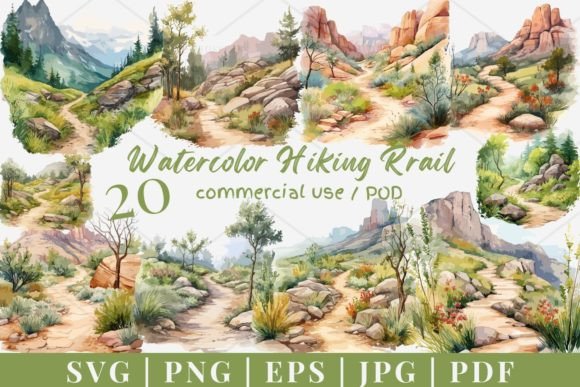
Opening 20 Hiking Trail Vector, SVG, PNG 956, I immediately noticed its gentle watercolor texture — soft edges, subtle pigment bleed, and organic line variation. It’s not a rigid technical map; it’s an invitation. Twenty distinct trail motifs, each with winding paths, mountain silhouettes, pine clusters, or compass accents — all rendered with intentional imperfection. That’s key for embroidery: this isn’t about pixel-perfect replication, but about translating mood into stitch. As a designer who regularly converts vector art to machine embroidery design, I appreciated how the shapes avoid micro-detail traps — no hair-thin branches or nested loops that would collapse under satin stitch or vanish on cotton twill.
A Real Test: Embroidering a Custom Hiking-Themed Tote Bag
Last week, I used one of the trails from 20 Hiking Trail Vector, SVG, PNG 956 on a natural canvas tote for a local outdoor guide service. The goal? A clean, recognizable emblem — not too literal, not too abstract — that felt handmade, not mass-printed. I chose the “loop trail with distant peaks” variant. After converting it to an embroidery file (using auto-digitizing with manual cleanup), I stitched it on a medium-weight canvas with tear-away stabilizer. The result held up beautifully: the watercolor softness translated into graceful fill stitch gradients, and the path’s curve flowed naturally across the bag’s slightly curved surface. Customers commented on how “warm” and “authentic” it looked — a direct lift from the original illustration’s personality.
Where It Shines (and Where It Needs Care)
20 Hiking Trail Vector, SVG, PNG 956 excels in projects where atmosphere matters more than engineering precision:
- Custom apparel: Sweatshirt embroidery and t-shirt designs benefit from its relaxed line weight — no harsh outlines fighting fabric drape.
- Tote bags & aprons: The moderate scale and open composition prevent visual crowding, even on textured weaves.
- Baby embroidery & nursery decor: Soft watercolor tones digitize well into low-density fill stitches, reducing stiffness on delicate fabrics.
- Holiday embroidery & personalized gifts: Trails evoke journey, growth, and quiet adventure — resonant themes for graduation, new parents, or milestone hikes.
- Etsy seller & small shop product: As digital embroidery file or printable mockup, it supports cohesive branding — imagine matching trail motifs across tea towels, pillow covers, and patch sets.
But realism matters. This is not ideal for:
- Embroidered patches requiring sharp, dense satin stitch borders — the watercolor edges blur when over-digitized.
- Caps or curved surfaces with tight hoops — some trail variants include fine tapering lines that risk stitch loss below 3" hoop size.
- Dark fabric without high-contrast thread colors — the subtle pigment layers fade unless paired with matte ecru or charcoal thread.
- Frequent-wash items like baby onesies — watercolor softness means lower stitch density; reinforce with lightweight cut-away stabilizer if durability is critical.
Design Judgment: Beyond Aesthetics to Customer Trust
When you choose 20 Hiking Trail Vector, SVG, PNG 956 for a finished product, you’re not just selecting graphics — you’re shaping perception. Its hand-drawn authenticity signals care. A customer receiving a sweatshirt with this trail motif doesn’t see clipart; they feel intention. That lifts perceived value, especially for handmade product buyers on Etsy or craft fairs. For boutique branding, it offers instant thematic cohesion — pair it with minimalist typography and kraft packaging, and you’ve got a full story. But it only works if the execution matches the promise. If stitching looks muddy or misaligned, the watercolor charm turns into “sloppy.” So test early, test often.
Practical Embroidery Designer Notes
Before committing to client work or inventory production with 20 Hiking Trail Vector, SVG, PNG 956, here’s what I do every time:
- Test on scrap fabric first — especially your target fabric (canvas, fleece, poplin) and stabilizer combo.
- Check thread color contrast in both natural and artificial light — watercolor palettes shift dramatically on dark vs. light backgrounds.
- Review stitch density manually in your embroidery software — reduce fill angles or add underlay if the design feels too sparse on stretchy fabric.
- Confirm hoop size compatibility — some trail motifs exceed 4"x4"; verify dimensions before digitizing.
- Inspect small details — does the compass rose or trail marker hold clarity at 2.5" wide? If not, simplify before stitching.
- Test black-and-white mockups — ensures legibility when color isn’t available (e.g., monochrome Etsy thumbnails).
- Compare light/dark fabric backgrounds — what reads as “soft” on ivory may disappear on navy without thread adjustment.
- Use proper stabilizer — medium tear-away for stable fabrics; cut-away + topping for knits or textured weaves.
- Verify licensing — since this is categorized as Illustrations and Graphics, confirm commercial use rights apply to your intended finished product or digital embroidery file resale.
Final Thought: A Thoughtful Tool, Not a Magic Button
20 Hiking Trail Vector, SVG, PNG 956 won’t replace thoughtful digitizing or fabric testing — but it gives you a strong, emotionally grounded starting point. It’s the kind of design that helps small shop owners tell a story without words, lets crafters create personalized gifts with instant resonance, and gives embroidery designers a versatile asset for custom apparel, holiday embroidery, or boutique branding. Used with attention — to thread, stabilizer, scale, and context — it becomes more than a download. It becomes part of the reason someone chooses your handmade product over another. And in today’s market, that quiet distinction is everything.