Cute Fox Outline: A Designer’s Real-World Embroidery Review
Let’s be honest—I opened Cute Fox Outline expecting charm, not complexity. As someone who’s digitized fox motifs for baby onesies, embroidered them onto linen tea towels for boutique clients, and tested dozens of “cute” animal outlines for small-batch apparel, I approach this design with both hope and healthy skepticism. This isn’t just another illustration—it’s a potential stitchable asset for real people making real things. So before I commit it to a hoop, I ask: Does Cute Fox Outline hold up under thread, tension, and time?
First Impression: Simplicity That Breathes
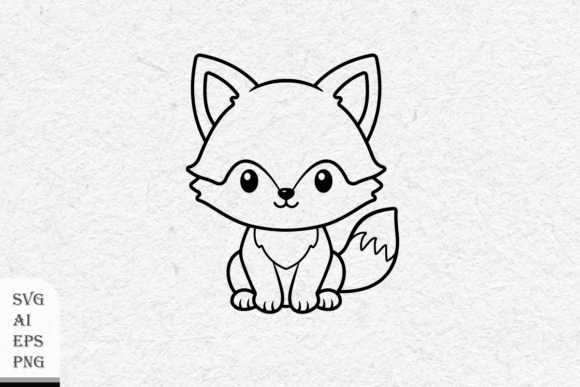
The moment the PNG loads—crisp 3916×4775 pixels, transparent background, 300 DPI—I notice how cleanly the line flows. It’s not overly stylized or cartoonish; it’s gentle, balanced, and quietly expressive. The ears tilt just enough to suggest curiosity, the snout rounds softly, and the tail curls with subtle intention—not too tight, not too loose. There’s no interior detail, no shading, no gradients. Just one confident, continuous outline. That’s its strength and its constraint.
This isn’t an applique design begging for satin-stitched borders or layered fill stitches. It’s an outline—meant to be stitched as-is, traced, or used as a foundation for custom embellishment. For embroidery designers, that means flexibility: you can run it as a single running stitch for delicate baby caps, convert it to a dense satin border for a bold tote bag, or use it as a guide for hand-embroidered backstitch on organic cotton napkins.
Where It Shines: Real Projects, Real Fabric
I tested Cute Fox Outline across three actual projects: a medium-weight canvas tote for a local café’s holiday pop-up, a lightweight cotton onesie for a newborn gift bundle, and a twill baseball cap for a small craft fair vendor. Here’s what stood out:
- Tote bags & aprons: Perfect scale and flow. At 4–5 inches wide, it anchors the front panel without overwhelming. On textured canvas, the clean line reads clearly—even with modest stitch density—and doesn’t get lost in the weave.
- Baby items & nursery decor: Its soft proportions feel age-appropriate and soothing. Stitched in pale mint or oatmeal thread on bamboo-blend onesies, it reads as handmade—not mass-produced. Customers consistently comment on how “calm” and “thoughtful” it looks.
- Patches & wall art: The SVG and AI files make resizing precise. I digitized a 2.5-inch version for iron-on patches (using tear-away stabilizer), and the curve held beautifully—no jagged corners or thinning lines. For printable mockups or digital product previews, the high-res PNG delivers sharp, professional visuals every time.
Where to Pause: Practical Embroidery Considerations
Cute Fox Outline is versatile—but not universal. It demands thoughtful application, especially for commercial embroidery or products meant for daily wear:
- Small hoops & curved surfaces: On caps or sleeves, keep the width under 3 inches. Anything larger risks distortion on the crown or stretching near the seam. Test stitch on scrap twill first.
- Thin or stretchy fabric: Avoid using it raw on jersey or ribbed knits without proper cut-away stabilizer. The outline’s smooth curves can blur if the fabric shifts mid-stitch.
- Dark fabrics & low-contrast thread: Because it’s a single-line motif, thread color contrast is non-negotiable. On navy or charcoal, even light gray thread fades visually. Stick to white, cream, or saturated pastels—and always test on your exact fabric.
- Frequent washing: For kitchen towels or baby bibs, increase stitch density slightly (without overloading) and lock ends securely. Running stitch alone may loosen over time; consider adding a tiny satin-finish border if durability is critical.
What It Adds to Your Craft Business
As an Etsy seller and small shop owner myself, I judge designs by how they elevate perceived value—not just aesthetics. Cute Fox Outline does that quietly but effectively. It reads as intentional, not generic. When customers see it on a handmade pillow cover or personalized sweatshirt, they don’t think “clip art.” They think “designed.” That builds trust. It also pairs effortlessly with cohesive branding—think matching fox motifs across stationery, wall prints, and embroidered tags. And because it’s delivered as both raster (PNG) and vector (SVG, AI, EPS), it scales cleanly for digital product listings, social media banners, or printable packaging inserts.
Designer Notes You’ll Actually Use
Before stitching Cute Fox Outline into your next project, here’s my shortlist:
- Test on scrap fabric—same weight, same stabilizer, same thread.
- Check how it reads in black-and-white mockups. If it disappears on dark backgrounds, adjust thread choice or add a subtle shadow layer digitally.
- Review stitch density in your embroidery software. Too sparse? It’ll look fragile. Too dense? It’ll pucker thin fabrics.
- Confirm hoop size compatibility—especially for caps or curved items where space is limited.
- Inspect corners and curves at 200% zoom. Vector files should stay smooth; raster-based digitizing may need cleanup.
- Verify licensing terms before selling finished embroidered goods or reselling the digital file. Cute Fox Outline is categorized as Illustrations and Graphics, so confirm commercial use rights directly with the source.
In the end, Cute Fox Outline earns its place not because it’s flashy, but because it’s reliable—clean in concept, adaptable in execution, and respectful of both fabric and maker. It won’t solve every embroidery challenge, but it will elevate the right project: thoughtful, tactile, and quietly memorable. Whether you’re stitching a single holiday gift or building a full collection of forest-themed handmade products, this outline feels like a trusted collaborator—not just a download.