Minimalist Line Drawing Leaves SVG Set
A Designer’s First Glance: Clean, Quiet, and Full of Intent
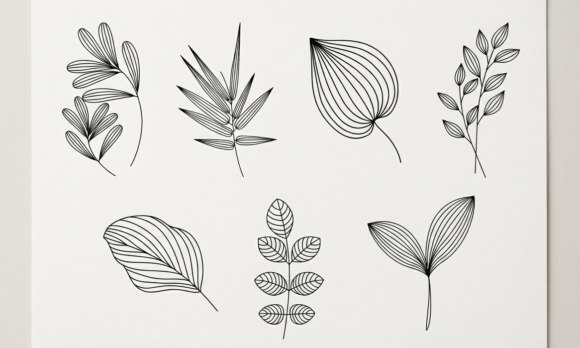
When I opened the Minimalist Line Drawing Leaves SVG Set, what struck me wasn’t complexity—it was confidence in restraint. These aren’t botanical illustrations trying to impress with veins or gradients. They’re single-line leaves drawn with deliberate rhythm: one continuous path, no closed loops, no fill areas—just quiet, fluid motion. The mood is calm but intentional—like a hand-drawn sketch you’d see on a linen tea towel or embroidered onto a baby onesie for a boutique nursery line. It’s not “cute.” It’s considered. That distinction matters when you’re choosing design assets for real products—not just digital previews.
Where This Set Lives Best: Real Projects, Not Just Pixels
I tested the Minimalist Line Drawing Leaves SVG Set as part of a custom embroidered tote bag order for a local herbalist—a small-batch shop selling dried botanicals and handmade soaps. We placed three subtly spaced leaves along the bottom hem, using black thread on natural canvas. The result? Elegant, legible, and quietly professional—no visual noise, no stitch pile-up, no need to over-explain the design. That’s the sweet spot: personalized gifts, small shop merchandise, and custom apparel where subtlety signals care, not compromise.
It works beautifully on sweatshirt embroidery—especially lightweight French terry—because the open-path nature avoids dense fill stitches that can stiffen fabric. On baby embroidery? Perfect for onesies or burp cloths: soft, uncluttered, and wash-friendly when stitched with quality stabilizer. As an embroidery file for patches, it translates cleanly into running stitch outlines—ideal for iron-on or sew-on applique designs meant to feel handmade, not mass-produced.
What You’ll Notice After Stitching—Not Just Before
Unlike many “minimalist” designs that collapse into indecipherable scribbles once stitched, these leaves retain their shape and flow across fabric types. On textured fabrics like linen or canvas, the single stroke reads clearly without getting lost in the weave. On stretchy fabric? Proceed carefully—use cutaway stabilizer and reduce tension slightly; the open path helps, but any curve needs support. On dark fabric, test thread color contrast first: a charcoal gray thread on navy reads softer than black, and keeps the minimalist tone intact.
One thing I appreciated: no tiny interior corners or micro-loops. That means fewer jump stitches, less thread breakage, and cleaner transitions between leaves—even when spacing them closely for a repeating border on a pillow cover or kitchen towel. For holiday embroidery or wedding gifts (think monogrammed napkins or linen sachets), this set adds refined texture without competing with text or other motifs.
Where to Pause—and Plan Ahead
- Small hoop sizes: Each leaf fits comfortably in a 4" hoop, but if you're arranging multiple leaves across a curved surface like a cap, map placement digitally first—some curves distort line weight.
- Thin or delicate fabric: Use tear-away + light cutaway combo stabilizer. A single-stroke design can look fragile if the fabric puckers around it.
- Dense stitch areas: Avoid layering this over heavy satin stitch or dense fill stitch zones—it’s meant to breathe, not compete.
- Frequent-wash items: Confirm stitch density isn’t too sparse—running stitch should have consistent spacing (not overly stretched) to hold up over time.
How It Shapes Perception—Beyond the Stitch
Customers don’t buy “SVG files.” They buy feeling—calm, intention, craftsmanship. The Minimalist Line Drawing Leaves SVG Set supports that. When used on an Etsy listing for personalized baby embroidery, it elevates perceived value without raising price points. On printable mockups for your craft business, it gives consistency across product photos—same clean line, same quiet authority. For boutique branding, it integrates seamlessly into packaging liners or thank-you cards, reinforcing a cohesive visual language.
It also builds trust. Buyers recognize when a design feels *made for embroidery*, not just adapted from a vector graphic. No floating nodes. No overlapping paths. No hidden anchor points. That professionalism shows in the finished product—and in how quickly clients approve proofs.
Practical Notes Every Embroidery Designer Should Keep Handy
- Always test the Minimalist Line Drawing Leaves SVG Set on scrap fabric first—especially if pairing with a new thread brand or stabilizer type.
- Review stitch density in your embroidery software: aim for 0.6–0.8mm stitch length for smooth running stitch flow.
- Confirm hoop size compatibility before digitizing—if your machine requires specific formats (e.g., PES, DST), convert only after verifying path integrity.
- Inspect small details at 200% zoom: look for unintended gaps or overlaps in the open path—some SVG editors add tiny breaks during export.
- Test both black and white thread on light/dark fabric backgrounds. Minimalism relies on contrast—don’t assume it’ll read the same way across all combinations.
- Use proper stabilizer—not just for hold, but for drape. A well-stabilized leaf on a linen apron moves with the fabric, not against it.
- Check licensing terms before using in commercial embroidery or selling finished items. Since this is marketed as a Graphics asset for Cricut and Silhouette, confirm whether it permits resale of physical products or digital embroidery files.
Final Thought: Less Isn’t Empty—It’s Loaded With Choice
The Minimalist Line Drawing Leaves SVG Set doesn’t shout. It invites attention by leaving space—for breath, for context, for the person wearing or gifting the item. As an embroidery designer and product reviewer, I reach for it when I want clarity over clutter, intention over ornament, and quiet strength over flash. It belongs in your toolkit not because it’s trendy—but because it works, reliably, across baby embroidery, custom apparel, holiday embroidery, and small shop product lines. And in the world of handmade product and craft business, that kind of quiet reliability? That’s gold.